
The bottom line: One-way SMS alerts force leads to switch channels to take action, creating friction that kills conversion. Two-way SMS lets leads complete tasks — pre-qualifying, receiving quotes, expressing interest — directly within the text conversation, eliminating drop-off and scaling lead nurturing on autopilot.
SMS is a great channel to nurture leads, but most agencies leave the real benefits on the table by relying on one-way text notifications and alerts.
It's no secret that SMS is your customer's preferred method of communication. According to Forbes, SMS consistently delivers open rates around 98%, compared to roughly 20–27% for email. The vast majority of text messages are read within minutes of delivery, making SMS one of the most immediate communication channels available. So why are your SMS efforts not drastically moving the needle to reduce overall acquisition cost and convert more leads later in the funnel?
The answer comes down to how you use the channel.
If you're sending manual one-to-one texts to customers, chances are you're spending a lot of your time managing your inbox for little payoff. Leads can drop off or get lost, and consistent nurturing takes time away from the ready-to-close leads. Manual texts simply don't scale — reps spend most of their time managing inboxes while ready-to-close leads wait, and consistent follow-up becomes impossible as volume grows.
To speed up the process, many sales teams now use traditional one-way platforms to send automated text messages — set up a workflow and fire off a text to anyone who enters the funnel or drops into a drip campaign with a link attached. But one-way texts force a customer to another channel like a website, email, or phone call to complete the process. Or worse, they aren't set up to handle any questions or requests a customer has in response.
There is a lot of room for drop-off in an already complex sales process, and there is little value in this text message for the customer. One-way texts don't convert.
Feature | One-Way SMS | Two-Way SMS |
|---|---|---|
Lead can reply | No — recipients cannot respond | Yes — full conversational capability |
Action required | Click a link, visit a website, or call a number | Complete tasks directly in the text thread |
Lead qualification | Not possible within the message | Leads pre-qualify, get quotes, and confirm interest inline |
Follow-up automation | Basic drip sequences only | Intelligent, personalized nurture for days or months |
Scalability | Scales sends, not conversations | Scales both sends and conversations |
CRM integration | Manual data entry required | Automatic — details sync in real time |
Drop-off risk | High — every channel switch is a drop-off point | Low — entire interaction stays in one channel |
The difference comes down to one thing: one-way SMS makes the lead leave the thread to act, while two-way SMS lets them reply, qualify, and convert without ever switching channels.
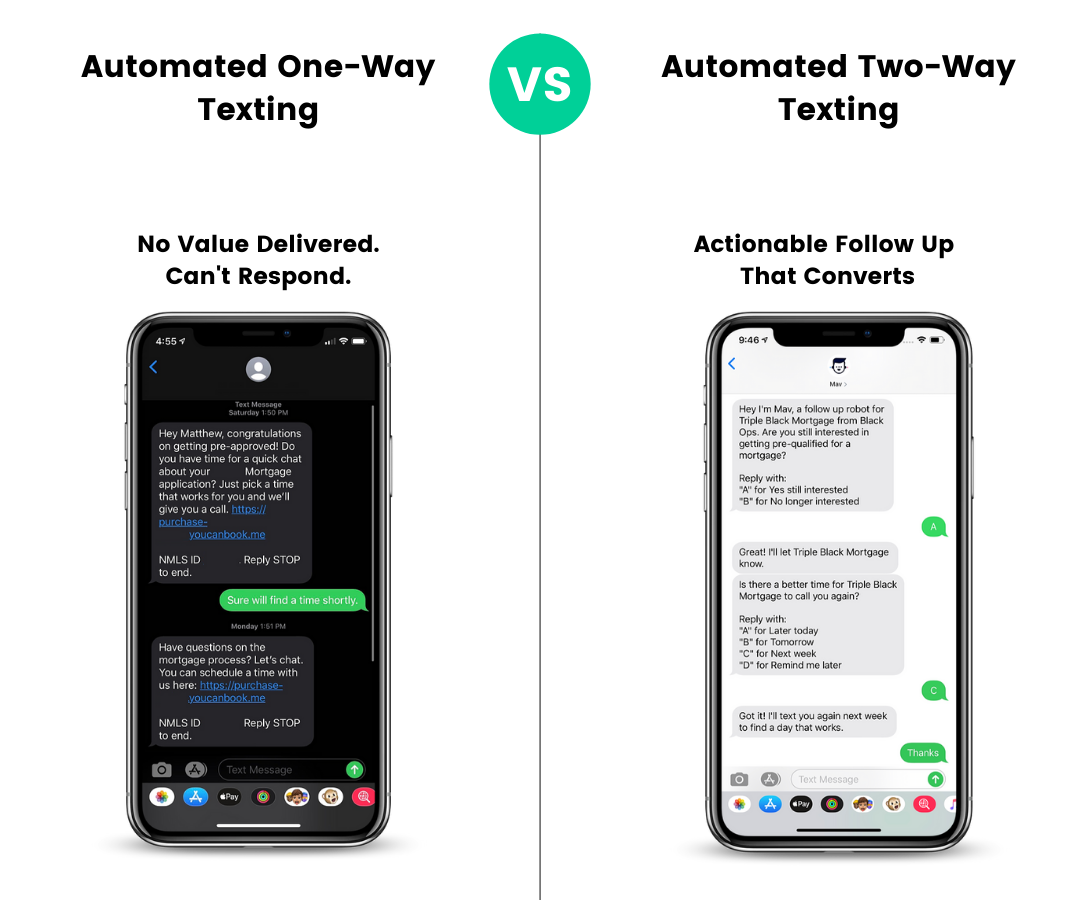
Automated two-way texting enables businesses to have a conversation with customers that they can reply to. In an automated conversation (between a customer and an AI agent) they can text back to complete tasks, like finishing pre-qualifying for a service, receiving a quote, finishing an application, or expressing interest in a timely offer, directly inline. This strategy makes text messages instantly valuable for your customer, and gives you the information you want at the same time: are they still interested or not.
When a lead drops off mid-conversation — perhaps they got distracted, needed more time to decide, or simply forgot to respond — the system automatically sends personalized follow-up texts at smart intervals and picks up the conversation right where it left off. All lead activity syncs to the CRM, so sales teams always know where each prospect stands without manually tracking follow-ups. This means no leads fall through the cracks just because timing was not right on day one. Explore how automated lead nurturing works.
When evaluating SMS platforms for insurance lead nurturing, look for these capabilities:
Mav — Purpose-built conversational AI for insurance. Handles two-way text conversations, lead qualification, CRM syncing, and live call transfers autonomously. Designed specifically for high-volume lead pipelines with instant speed-to-lead. Learn more.
Twilio — Programmable messaging API that supports two-way SMS. Requires custom development to build conversational flows. Best for teams with engineering resources who want full control over their messaging infrastructure.
Podium — Customer interaction platform with two-way texting, review management, and payment processing. Popular with local businesses and agencies that want an all-in-one front desk solution.
Sakari — SMS marketing platform with two-way messaging, automation workflows, and CRM integrations. According to Sakari, SMS campaigns average around 45% response rates compared to roughly 6% for email, with conversion rates reaching 21–30% in well-optimized programs.
Heymarket — Business texting platform with shared inboxes, templates, and two-way SMS. Designed for teams that need to manage high-volume text conversations across multiple reps.
The key differentiator for insurance agencies is whether the platform can handle autonomous, AI-driven conversations — not just send and receive messages. Tools that simply enable two-way replies still require human reps to manage every conversation. Platforms like Mav automate the entire nurture and qualification flow, freeing your team to focus on closing.
By using automated two-way texting to re-engage leads at various points in the funnel, you can nurture them on autopilot for days or even months. Your AI agent will nurture customers in your pipeline and follow up until they're ready to take the next steps, and your sales team can focus on the highly qualified, hot leads. The process is fully autonomous, and the agent sends the details to your CRM so you know exactly where your customers are in the process and when they're ready to act. One-way automated texts can't do any of that.
We know that speed is important when it comes to successful customer acquisition and nurturing strategies, but knowing which leads are interested and ready to move can be a guessing game. New opportunities are lost, and qualified leads become cold while they wait to be contacted. Using the data you already have, you can programmatically trigger texts to leads with new offers at the exact right time. This optimizes your re-engagements for real results.
Key insight: Programmatic text triggers based on existing data let businesses re-engage leads with relevant offers at the exact right time. This replaces the guesswork of manual follow-up with data-driven outreach optimized for real results.
Understanding current benchmarks helps you set realistic goals for your SMS programs:
SMS open rate: ~98% (Forbes)
Email open rate: ~20–27%
SMS response rate: ~45% (Sakari)
Email response rate: ~6%
SMS conversion rate (optimized programs): 21–30% (Sakari)
These numbers underscore why SMS — particularly two-way conversational SMS — is the highest-leverage channel for insurance lead nurturing. Pairing high SMS open rates with AI-powered two-way conversations turns visibility into actual engagement.
The question isn't whether SMS works for lead nurturing — the data is clear. The question is whether you're using SMS in a way that actually drives conversion. One-way alerts get read but don't convert. Two-way conversations get read, engage, qualify, and close.
Want to learn more about how Mav can help you start having automated two-way conversations with your customers? Get started here.
One-way SMS sends automated text messages that recipients cannot reply to — typically promotional blasts or drip campaign messages with a link attached. Two-way SMS enables an actual conversation where leads can text back to complete tasks like pre-qualifying for a service, receiving a quote, or confirming interest directly within the messaging thread. The key advantage of two-way texting is that it keeps the entire interaction in a single channel, eliminating the friction of redirecting leads to a website, email, or phone call. For a deeper comparison, see how automated two-way texting works.
One-way texts fail because they force customers to switch channels to take action. When a lead receives a text with a link to a website or a prompt to call a phone number, every additional step creates an opportunity for drop-off. Worse, if a lead replies with a question or request, one-way platforms have no way to handle that response — leaving the customer ignored. The text itself delivers little value to the recipient, and in an already complex sales process, that channel-switching friction kills conversion. Learn more about why texts are not converting and how to fix it.
SMS consistently delivers open rates around 98%, compared to roughly 20–27% for email, according to Forbes. The vast majority of text messages are read within minutes of delivery, making SMS one of the most immediate communication channels available. For lead nurturing specifically, this means outreach via text reaches prospects far more reliably than email, where messages often sit unread for hours or end up in spam folders. Pairing high SMS open rates with AI-powered two-way conversations turns that visibility into actual engagement.
Automated two-way texting removes the burden of manual follow-up by nurturing leads on autopilot for days or even months. When a lead drops off mid-conversation — perhaps they got distracted, needed more time to decide, or simply forgot to respond — the system automatically sends personalized follow-up texts at smart intervals and picks up the conversation right where it left off. All lead activity syncs to the CRM, so sales teams always know where each prospect stands without manually tracking follow-ups. This means no leads fall through the cracks just because timing was not right on day one. Explore how automated lead nurturing works.
Yes. Automated two-way SMS handles unlimited lead volume without requiring additional headcount. According to Sakari, SMS campaigns average around 45% response rates compared to roughly 6% for email, with conversion rates reaching 21–30% in well-optimized programs. Because the system is fully autonomous — triggering texts based on CRM data, following up automatically, and routing qualified leads to sales reps — businesses can scale from hundreds to thousands of leads without proportionally increasing staff or losing consistency. The process works the same way whether you are nurturing 100 leads or 10,000. Learn more about Mav's approach to SMS for insurance leads.
Last Updated: June 2026


